AI in the Enterprise
Why Hybrid AI Architectures Are Becoming the New Standard
The use of artificial intelligence has become firmly established across enterprises. Generative AI systems from the SaaS ecosystem are now widely used for content creation, analysis, and productivity-focused knowledge work. At the same time, regulatory requirements are increasing significantly. With the GDPR and the European AI Act, transparency, traceability, and responsible data handling are gaining importance in corporate decision-making.
This shift changes the focus. The key question is no longer about selecting individual tools, but about the underlying architecture. The real challenge is how different AI systems can be combined in a way that enables innovation, efficiency, and compliance at the same time.
SaaS AI and Sovereign AI: Two Different Logics
Enterprise AI does not follow a single logic but rather different operational principles.
SaaS AI is optimized for scalability, model quality, and fast availability. It is particularly well suited for creative and knowledge-intensive tasks where speed and output quality are the main priorities.
Sovereign AI, on the other hand, follows a different principle. It focuses on data ownership, controlled processing, and regulatory compliance requirements.
The key point is not the model itself, but the context in which the data is used.
Why the Question of “the Best AI” Falls Short
In many organizations, AI is still discussed in terms of selecting individual tools. This perspective is too narrow because it ignores differences in data sensitivity and protection requirements.
In practice, requirements vary significantly:
- Internal brainstorming requires maximum flexibility and speed
- HR or financial data requires control, traceability, and compliance
- Strategic corporate data sits in between and requires layered security models
These differences naturally lead to the need for multiple AI systems to operate in parallel.
Practical Example: Hybrid AI Is Already Reality
In practice, many companies are already using hybrid AI setups—often without explicitly labeling them as such. A marketing team, for example, uses SaaS-based AI systems to develop campaign ideas, draft texts, or generate content variations. These systems are particularly strong in creative and iterative processes.
At the same time, sensitive information such as employee data, contracts, or financial figures is not processed in these systems but handled in controlled, internally managed, or specially secured environments.
Both systems therefore coexist, each with clearly separated roles within the same AI strategy.
Challenges When Using SaaS AI
SaaS-based AI systems can generally be used in a GDPR-compliant manner, provided that technical and organizational measures are properly implemented. However, in practice, the assessment strongly depends on the specific use case.
This becomes particularly relevant when dealing with:
- sensitive personal data
- confidential corporate knowledge
- highly regulated industries
Another key aspect is data control. In externally operated systems, parts of the data processing take place outside the organization’s direct control. This includes storage locations, processing pathways, and potential use of inputs for model improvement, depending on the provider and contractual terms.
Strategic dependencies also arise, such as:
- API access
- pricing and licensing models
- product cycles and model availability
These factors are not necessarily critical in day-to-day operations but should be considered strategically.
Sovereign AI as an Architectural Principle
Sovereign AI is not a single product but an architectural approach. At its core, it is about designing AI systems to operate within clearly defined technical and regulatory boundaries.
The goal is not complete isolation, but rather controlled management of data and model flows.
Typical building blocks include:
- deployment in private clouds or controlled European infrastructure environments
- data classification based on sensitivity levels
- role-based access control systems
- separation of security and trust zones
The objective is to ensure transparent control over where and how data is processed.
Compliance as Part of the Architecture
Modern AI architectures treat compliance not as a post-deployment activity, but as a core design element.
This includes data residency and geographic processing requirements, auditability through logging and monitoring systems, identity and access management, and clearly defined security and trust zones.
As a result, compliance becomes a technical design parameter that directly shapes the architecture.
No Quality Advantage from Sovereign AI
A common misconception is that sovereign AI systems automatically deliver better performance.
This is not the case.
The most advanced foundation models currently come predominantly from global providers. The advantage of sovereign architectures therefore lies not in model quality, but in control, governance, and risk management.
European Providers and the Emerging Ecosystem
The European enterprise AI market is evolving rapidly. The focus is less on maximum model performance and more on data sovereignty and regulatory alignment.
Examples include companies such as Mistral AI, which develops powerful models and open-weight approaches, and Aleph Alpha, which focuses on sovereign AI systems for regulated environments.
This ecosystem is complemented by platform providers such as Langdock, which enable secure use of multiple language models, and providers such as LightOn, which specialize in controlled enterprise environments.
Infrastructure providers such as IONOS also play an important role, as they form the foundation for sovereign AI architectures.
Hybrid AI Architectures as a Realistic Standard
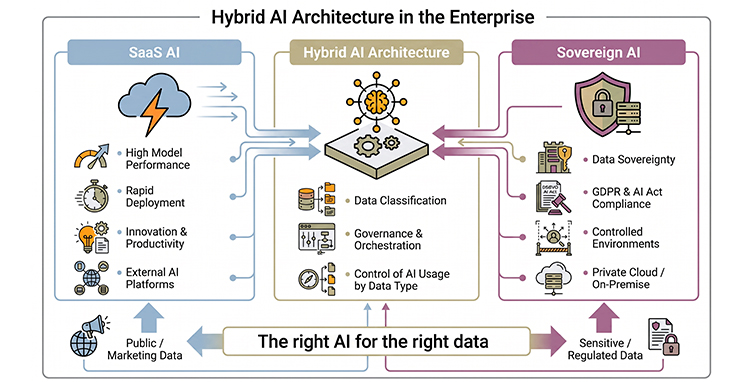
In enterprise practice, a hybrid approach is increasingly the norm, where different AI systems are used in parallel.
SaaS AI is typically applied wherever speed, creativity, and scalability are the primary requirements, such as in marketing, content creation, or general-purpose assistance tasks without sensitive data.
Sovereign AI, on the other hand, is used in areas where security and regulatory requirements dominate, such as HR, financial, and strategic corporate data, as well as compliance-critical processes.
Conclusion: Architecture Matters, Not the Model
The key question in modern AI strategy is no longer which model is best, but which data is allowed to be processed in which system.
Future-proof AI strategies therefore combine different approaches in a targeted way:
- SaaS AI for innovation, speed, and scalability
- Sovereign AI for control, compliance, and data sovereignty
Long-term success depends less on individual models and more on a clear data strategy, strong governance, and an architecture that systematically integrates different requirements.
Quelle: SVP-Research